

What Is a Queue Management System? US Business Guide 2026
Written by Paul Harnett, Founder of QueueAway. Last updated: May 2026.
Everything US businesses need to know about queue management systems — how they work, the types available, what the data says, and how to choose the right one.
US businesses lose an estimated $130 billion every year due to poor wait experiences. Not from bad products or weak staff — from queues that go unmanaged, waits that feel endless, and customers who leave before they're served.
Queue management has quietly become one of the most important operational decisions a US business can make. This guide breaks down exactly what a queue management system is, how it works, what the data says about American customer behaviour, and how to choose the right solution for your business.
Losing customers to long waits? QueueAway fixes that in under 30 minutes.
No hardware. No app download for customers. Free 14-day trial — no credit card needed.
What Is a Queue Management System?
QueueAway cuts customer wait times by 40% by replacing the clipboard-and-guesswork queue most US businesses still run with a real queue management system (QMS) — a digital way to track, organise, and manage customer flow, so "we think Saturdays are busy" becomes an actual, measurable picture of how customers move through the door.
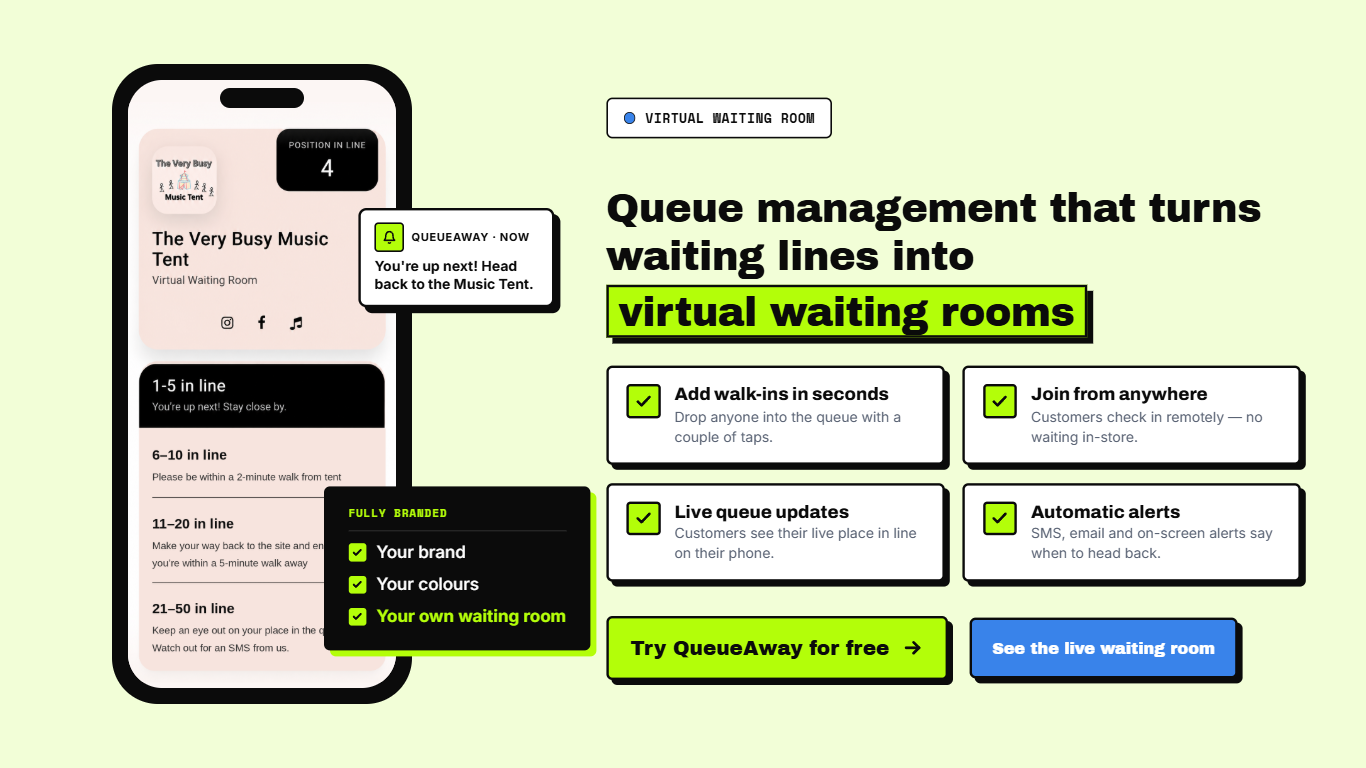
In practical terms: instead of customers standing in a line not knowing how long they'll wait, a QMS gives them a place in the queue, an estimated wait time, and real-time updates. Staff manage everything through a central dashboard. When a customer's turn arrives, they're notified and ready.
Modern systems go well beyond a simple ticket machine. They handle:
Virtual check-in via QR code, website, app, or kiosk
Real-time queue position and wait time updates via SMS or mobile
Staff dashboards for managing flow across multiple service counters
Analytics on peak hours, average wait times, and staff efficiency
Integration with CRM, POS, and scheduling software
Why Queue Management Matters More Than Ever in the US
American consumers have grown significantly less patient with waiting — and the data backs this up.
A major 2025 consumer survey on waiting behaviour found that 84% of US consumers say they avoid visiting a business if they anticipate having to wait in line. When faced with an actual queue, 39% will switch to a competitor or abandon their purchase altogether.
The tolerance threshold is also shrinking. Industry research compiled in 2026 found that the average customer will abandon a queue after just 8 minutes — and retail customers have even less buffer, with checkout waits of 8–12 minutes already pushing many to their limit. For a deeper look at how this plays out in the US, see our research on how long Americans will wait in line.
What makes this particularly costly is the long-term damage. Studies show that 70% of customers are less likely to return to a store after experiencing long queues even once, and negative wait experiences generate 2.5 times more online reviews than positive ones (BrightLocal Local Consumer Review Survey 2025).
The good news: the fix is largely structural, not staffing. And it's measurable.
The Business Case: What the Numbers Show
The ROI on queue management systems is well documented.
Data from over 5,000 retail locations shows that effective queue management reduces average wait times by 40% compared to traditional approaches, and manages customer flow 60% more efficiently during peak hours.
Businesses implementing digital queue solutions report average productivity gains of 22% within the first six months. Explore the full list of QueueAway features that make this possible.
Perhaps most importantly for conversion: providing real-time queue updates causes customers to perceive their wait as 35% shorter than those who receive no updates — even when actual wait times are identical (Journal of Service Research, 2025). Managing perception is as valuable as managing the queue itself.
For restaurants specifically, the numbers are stark. A mid-sized restaurant serving 200 walk-in customers per week, with a 10% walkout rate, loses roughly $46,800 annually in revenue from customers who leave due to wait times alone (Toast Restaurant Technology Report 2025).
QueueAway customers reduce wait times by up to 40% from day one. See how it works →
How a Queue Management System Works
Most modern systems follow a straightforward process:
Customer joins the queue — via QR code scan, website link, mobile app, or in-person kiosk
Position is assigned — the system issues a queue number and estimated wait time
Real-time updates — SMS or in-app notifications keep the customer informed as they move forward
Staff manage from a dashboard — a central view of all customers in the queue, service times, and counter activity
Service is delivered — the customer is called when it's their turn, reducing crowding and no-shows
Customers can wait anywhere — in their car, browsing the store, or nearby — rather than standing in a physical line. This also reduces perceived wait times and the frustration that comes with uncertainty.
The Science Behind Queuing: Why Lines Form the Way They Do
Understanding why queues become problematic helps explain why software-based management works so well. The mathematics behind waiting lines — known as queuing theory — was first developed by Danish engineer A.K. Erlang in the early 1900s to model telephone traffic. Today it underpins how every modern queue management system is built.
Queuing theory identifies four key variables that determine how a queue behaves:
Arrival rate — how frequently customers arrive. In retail, this is rarely steady — it surges at lunch, after work, and on weekends. Most businesses understaff for these peaks because they're managing by feel rather than data.
Service rate — how quickly each customer is served. Even small improvements here (faster check-in, pre-collected information) significantly reduce overall wait times.
Utilisation rate — the ratio of arrival rate to service rate. Once this exceeds around 80%, queues grow exponentially rather than linearly. A business that feels "nearly full" is often already past the point where wait times are controllable without intervention.
Queue discipline — the rules governing who gets served in what order. First-in-first-out is the default, but smart systems can prioritise by appointment type, customer need, or service complexity.
The critical insight from queuing theory is that perceived wait time and actual wait time are different problems. A customer who knows they are 4th in line and will wait 12 minutes feels calmer than one who has been standing for 8 minutes with no information. Queue management systems solve both — reducing actual waits through better flow, and perceived waits through real-time transparency.
Types of Queue Management Systems
Not all systems are the same. The right type depends on your business size, industry, and the nature of customer visits.
Virtual Queue Systems
Customers join remotely via QR code or link and receive SMS updates. No physical presence required until it's their turn. Best for: barbershops, salons, service businesses, and any walk-in environment where customers currently queue on arrival.
Appointment-Based Systems
Combines scheduling with queue management — customers book a time slot and arrive when ready. Best for: healthcare clinics, financial services, and any business where appointments are the primary model.
Kiosk-Based Systems
Physical check-in terminals at the entrance issue tickets or digital positions. Best for: government offices, large retail environments, and high-volume service locations.
Hybrid Systems
Merges walk-in queues and scheduled appointments into a single dashboard. Best for: businesses managing both — retail banks, urgent care centers, and multi-service locations.
Queue Management Across US Industries
Retail
Retail is the epicenter of the queuing problem in the US. Since 2023, the frequency of retail waits has surged by 28%, and retail lines are now four times more common than in any other industry.
83% of shoppers consider fast-moving queues an essential part of the customer experience, and 76% say stores should be doing more to reduce queues during busy periods (LLCBuddy, 2025).
Queue systems help retailers manage checkout congestion, reduce peak-hour pressure, and keep customers in-store rather than walking out. Learn more about queue management for retail, or read our breakdown of queue abandonment in retail and what causes it.
→ See how QueueAway works for retail businesses
Healthcare
The US records over 1 billion physician office visits annually and 155.4 million emergency department visits — yet only 40.6% of ED patients are seen within 15 minutes. Healthcare environments are under enormous flow management pressure.
30% of patients prefer to leave without seeing a doctor if they experience long wait times (LLCBuddy, 2025). Queue systems help clinics and hospitals reduce waiting room overcrowding, improve appointment adherence, and give patients visibility into their wait — which directly reduces anxiety and complaints. See how this works in practice on our healthcare queue management page, and explore our US healthcare waiting room statistics for supporting data.
→ Explore QueueAway for healthcare clinics
Restaurants and Hospitality
Restaurant guests on a waitlist wait around 20 minutes on average, while 45% of reservations in Q3 2024 were same-day — putting intense pressure on front-of-house teams to manage demand in real time (QueueAway US Statistics, 2026).
Virtual waitlists allow restaurants to seat customers more efficiently, reduce no-shows through SMS reminders, and turn the wait into an opportunity rather than a friction point. Read more about queue management for hospitality or our guide to restaurant waitlist management.
→ How QueueAway manages restaurant waitlists
Government Services
Many US government service environments — DMV offices, licensing centers, municipal buildings — still operate on physical queuing systems. With high daily visitor volumes and strict accessibility requirements, digital queue systems offer significant efficiency gains while supporting ADA compliance and multilingual access.
Barbershops and Service Businesses
Walk-in service businesses face a unique challenge: customers arrive unpredictably and have a low tolerance for uncertainty. A virtual queue lets customers check in on arrival, see their position, and return when it's their turn — dramatically reducing walk-aways and improving the experience for both customers and staff. See how this works for barbershop queue management.
→ QueueAway for barbershops — cut walk-aways, not just hair
Key Features to Look for in a US Queue Management System
When evaluating options, prioritise these for a US business context:
ADA Compliance — Accessibility features are a legal and ethical requirement. Look for systems that support customers with disabilities at every touchpoint.
Multilingual Interfaces — In a multicultural market, the ability to serve customers in their preferred language matters. Look for 50+ language support.
Real-Time Analytics — Wait time tracking, peak hour reporting, and staff performance data let you make operational decisions with evidence, not guesswork. See the full benefits of QueueAway.
SMS and Mobile Notifications — The primary channel for keeping customers updated without requiring a downloaded app.
Cloud-Based Architecture — Enables access from anywhere, scales with demand, and keeps deployment costs low. Cloud QMS platforms are growing at 11% CAGR versus on-premise alternatives (Mordor Intelligence, 2026).
Multi-Location Support — If you operate more than one site, centralised management across all locations is essential.
Integration Capabilities — Syncing with your existing CRM, POS, or scheduling software prevents double-handling and gives a complete view of the customer journey.
What to look for
Virtual check-in via QR code
Real-time SMS updates
Staff dashboard
Analytics & peak-hour reporting
ADA compliant
50+ language support
Multi-location management
No hardware required
Free trial available
QueueAway
✅
✅
✅
✅
✅
✅
✅
✅
✅ 14 days, no card needed
The Market Is Moving Fast
The global queue management system market is valued at $43.67 billion in 2026 and is projected to reach $77.13 billion by 2031 — a 12% annual growth rate. North America accounts for 35.95% of global revenue, the largest share of any region (Mordor Intelligence, 2026).
Adoption is accelerating across all business sizes. In 2026, approximately 39% of small businesses, 68% of mid-market companies, and 89% of enterprises now use some form of digital queue management (Grand View Research, 2025).
The businesses still relying on physical queuing are increasingly the outliers — and their customers notice. For more data, see our queue management statistics for the USA.
Why Virtual Queuing Is the Default Choice
Physical queues ask customers to give up their time and their autonomy. Virtual queuing gives both back. For a full comparison, read our guide to virtual queues vs physical lines.
With a virtual system, customers check in, receive a position, and go about their day until it's their turn. Nearly 65% of US consumers now prefer appointment scheduling or virtual queues over physical lines, and 45% of customers continue shopping or spending while waiting in a virtual queue — turning wait time into revenue rather than friction.
For staff, the benefits are equally tangible. When queues are managed digitally, significantly fewer retail workers face frustrated or angry customers — directly reducing burnout and improving retention.
For a step-by-step look at how it works, plus features, rollout and pricing, read our guide to the virtual queue management system
Traditional Queuing vs Modern Queue Management: A Direct Comparison
Customer experience
Abandonment rate
Staff workload ………………
Peak hour handling …………..
Data & insights ……………………
Customer return rate
Setup cost ……………………………….
Scalability
Traditional Physical Queue
Stand in line with no information
High — no visibility leads to walkouts
Manual crowd management required
Queues grow uncontrolled
None …………………………………………………………..
Reduced after bad wait experience
Low (no system needed) ………………………
Difficult — requires more staff
Modern Queue Management System
Wait anywhere with real-time updates
Significantly lower — transparency reduces frustration
Automated — staff focus on service ……………………..
System manages flow and alerts staff to surge
Full analytics on wait times, peak hours, throughput
Improved — positive experience drives loyalty
Low to moderate — cloud systems need no hardware
Easy — system scales with demand
The hidden cost of traditional queuing isn't the queue itself — it's the revenue lost from customers who leave, don't return, or leave a negative review. When those costs are factored in, the ROI case for a modern QMS becomes straightforward.
5 Queue Management Mistakes US Businesses Make
Even businesses that invest in a queue management system often leave performance on the table. These are the most common errors to avoid.
1. Treating it as a one-time setup A queue management system produces data — peak hour patterns, average service times, abandonment rates. Businesses that install and forget miss the ongoing optimisation that compounds over time. Review your analytics monthly and adjust staffing and service workflows accordingly.
2. Not communicating the virtual queue to customers A QR code on the door only works if customers know to look for it. Businesses that don't actively direct customers to their virtual queue — through signage, staff prompts, and social media — see lower adoption and the same physical crowding they were trying to solve.
3. Setting unrealistic wait time estimates Customers will accept a 20-minute wait far more readily than a 10-minute wait that turns into 25. Optimistic estimates backfire. Accurate or slightly conservative estimates build trust and reduce frustration even when waits are genuinely long.
4. Ignoring the no-show problem Virtual queues can increase no-shows if not managed well. SMS reminders timed correctly — one when the customer is 3–4 positions away — dramatically reduce this. Make sure your system is configured to send timely prompts, not just a single confirmation at check-in.
5. Choosing based on price alone The cheapest system rarely handles peak-hour surges, multi-location management, or integration with existing tools. Calculate the cost of a single bad Saturday — in lost sales, staff stress, and negative reviews — and the pricing of a robust system looks very different.
How to Get Started with a Queue Management System
Getting set up with a modern virtual queue system is significantly simpler than most businesses expect. With QueueAway, the process takes under 30 minutes:
Create your account — sign up for a free trial, no credit card required
Configure your queue — set your service types, estimated service times, and opening hours
Generate your QR code — print and display it at your entrance, on your website, or share via social media
Go live — customers scan, join the queue, and receive SMS updates automatically
Review your dashboard — monitor wait times, queue length, and peak patterns from day one
No hardware to install. No app download required for customers. No IT team needed.
Start your free trial → | View pricing →
How Much Does a Queue Management System Cost?
Pricing for queue management systems varies widely depending on the features, number of locations, and scale of use. There are broadly three pricing models in the market:
Per location / per month — the most common model for small to mid-size businesses. Costs typically range from $30 to $200/month per location depending on features included.
Per user / per staff member — common in enterprise systems. Scales with team size rather than customer volume.
Usage-based — charged per customer served or per SMS sent. Can be cost-effective at low volumes but unpredictable at scale.
For most US small businesses, a single-location monthly subscription with SMS notifications included is the most straightforward option. Look for systems that offer a free trial so you can validate the setup before committing.
Stop losing customers to queues.
QueueAway is used by retailers, clinics, barbershops and restaurants across the US. Customers join your queue by scanning a QR code — no app needed. You manage everything from one dashboard.
Setup takes under 30 minutes.
Frequently Asked Questions
What is a queue management system?
It depends on your business type — a retail store, a healthcare clinic, and a barbershop all use one differently, though the goal is the same: no one wandering the floor wondering when they'll be seen. See how it works for your industry →
How do queue management systems work?
Customers join a queue via QR code, website, app, or kiosk. The system assigns their position, provides estimated wait times, and sends notifications when it's their turn. Staff manage everything through a central dashboard. Explore QueueAway's features →
Why are queue management systems important for US businesses?
US businesses lose an estimated $130 billion annually from poor wait experiences. Queue management systems reduce abandonment, improve customer satisfaction, and increase operational efficiency — particularly in high-volume environments. For the data behind this, see our queue management statistics for the USA.
What types of businesses use queue management systems?
Retail stores, healthcare clinics, restaurants, barbershops, government offices, banks, and any business managing in-person customer flow. Browse our industry pages: Retail · Healthcare · Barbershops · Hospitality · Events & Venues
What's the difference between a virtual queue and a physical queue?
A physical queue requires customers to wait on-site. A virtual queue allows them to check in digitally, see their position, and return when it's their turn — reducing crowding and improving the experience. Read our full breakdown: Virtual Queues vs Physical Lines.
Are queue management systems suitable for small businesses?
Yes. Modern cloud-based systems are priced for businesses of all sizes, with no hardware required and quick setup. See QueueAway's simple queue management →
How much do queue management systems cost?
Pricing varies by features and business size. See QueueAway's pricing →
Does a virtual queue really reduce perceived wait times?
Yes. Research from the Journal of Service Research (2025) found that customers who receive real-time queue updates perceive their wait as 35% shorter — even when actual wait times are identical. See the full benefits of virtual queuing →
Sources
State of Waiting in Line 2025, consumer survey research
Queue Management System Market Report 2026, Mordor Intelligence
Queue Management System Market Report 2025, Grand View Research
Local Consumer Review Survey 2025, BrightLocal
Restaurant Technology Report 2025, Toast
Journal of Service Research, 2025
Queue Management Software Statistics 2025, LLCBuddy
National Retail Federation (NRF), retail foot traffic data 2025
Based in the UK? Read our UK guide to queue management systems →